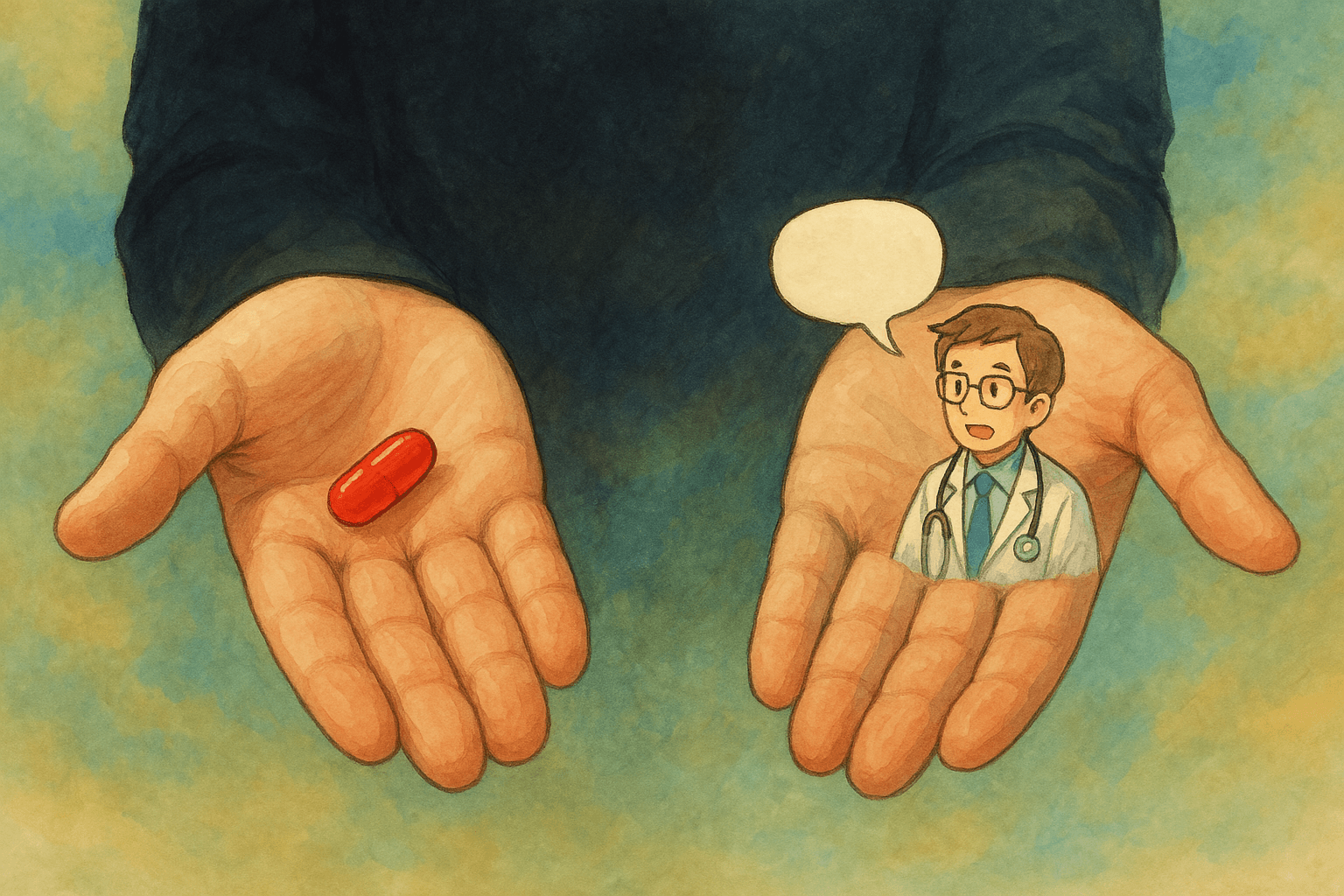
Imagine taking an antidepressant… only to discover that its effectiveness depends largely on what your doctor tells you about it, rather than the chemical properties of the pill itself.
This is exactly what a fascinating 2017 study published in eBioMedicine demonstrated.
It challenges the idea that psychiatric drugs work solely through their pharmacology and highlights the powerful role of expectations and context.
The Experiment That Shook Psychiatry
In this clinical trial, Swedish researchers recruited 47 patients with Social Anxiety Disorder (SAD) and divided them into two groups:
- Overt Group: Patients were told the truth — that they were receiving a well-established antidepressant, escitalopram.
- Covert Group: Patients received the exact same drug, but were told it was an “active placebo” with no effect on anxiety.
After 9 weeks, the results were striking:
- In the Overt group, 50% of participants experienced a clinically significant improvement.
- In the Covert group, only 14% saw their symptoms improve.
Yet both groups were taking the exact same dose of escitalopram!
Visible Changes in the Brain
The researchers went beyond symptom questionnaires. Using functional MRI scans, they observed clear differences between the two groups.
The Overt group showed increased activation in key brain regions involved in emotion and cognition, such as the posterior cingulate cortex.
Both groups exhibited reduced amygdala activity (a brain region linked to anxiety), but this reduction was much stronger in the Overt group.
In other words: the brain itself changed depending on what patients believed they were taking.
This Effect Isn’t New: Antidepressants vs. Active Placebos
The role of expectations isn’t just a recent discovery.
Back in 2004, a systematic review published by the Cochrane Collaboration compared antidepressants with active placebos — substances designed to mimic side effects but without any actual antidepressant action.
The findings were revealing:
Antidepressants showed only a small advantage over active placebos, with a difference of about 0.39 standard deviations.
This gap is much smaller than when comparing antidepressants to standard (inert) placebos.
When side effects don’t give away who’s taking the real drug, the difference between antidepressant and placebo almost disappears.
The Bigger Picture: 82% of the Effect Is Placebo
In 2008, psychologist Irving Kirsch and his team conducted a meta-analysis of all clinical trials submitted to the FDA.
Their conclusion:
82% of the improvement observed with antidepressants could be attributed to the placebo effect.
The actual drug effect was clinically meaningful only in patients with severe depression.
In other words, even the regulatory data shows that expectations and context often matter more than the drug itself for most patients.
Why This Matters
These studies remind us that medications don’t work in isolation.
The patient’s beliefs, expectations, and relationship with their clinician profoundly shape how effective a treatment will be.
This raises a critical question:
How often do we attribute the benefits of an antidepressant to its chemistry, when much of its power comes from the way it is presented?
References
Frangos E, et al. Do You Believe It? Verbal Suggestions Influence the Clinical and Neural Effects of Escitalopram in Social Anxiety Disorder: A Randomized Trial. eBioMedicine, 2017. DOI: 10.1016/j.ebiom.2017.10.018
Moncrieff J, Wessely S, Hardy R. Active placebos versus antidepressants for depression. Cochrane Database Syst Rev. 2004;(1):CD003012. DOI: 10.1002/14651858.CD003012.pub2
Kirsch I, Deacon BJ, Huedo-Medina TB, et al. Initial severity and antidepressant benefits: a meta-analysis of data submitted to the FDA. PLoS Med. 2008;5(2):e45. DOI: 10.1371/journal.pmed.0050045